32.7 miles – The average distance people go to escape living in Greenwich

170 v3.jpg

“How far do Greenwich people go to move to a new house?” This was an intriguing question asked by one of my clients the other week. Readers of my property blog will know I love a challenge, especially when it comes to talking about the Greenwich Property Market!

For the majority, the response is not very far. It is much more common for homeowners and tenants in Great Britain to move across town than to the next town or county. Until now, it’s been hard to say how many homeowners and tenants moved from (and to) relatively far away to buy or rent their new home. However, I carried out some research and requested some statistics from the Royal Mail. What came back was fascinating!

Using statistics for the 12 months up to the middle of Autumn 2016, 800 households moved out of Greenwich (SE10), moving an average distance of 32.78 miles – the equivalent of moving from Greenwich to Luton (as the crow flies).  The greatest distance travelled was 464 miles – that’s more than 17.5 marathons (when someone moved to Invergordon in Scotland).

Considering there were 414 property sales in SE10 in the year and countless tenant moves, the numbers seems consistent – once you find a town you like, you tend to want to settle down and if you do move, you might only move to a different neighbour-hood, or for better transport links or, to be closer to the school you want to get your children into, but the likelihood is you won’t travel far.

I then turned my attention to people moving into Greenwich. Using the same statistics for the 12 months up to the middle of Autumn 2016, 583 households moved into Greenwich (SE10), moving an average distance of 18.77 miles – the equivalent of moving from Leatherhead to Greenwich (again as the crow flies). The greatest distance travelled was 449 miles – that’s more than 17 marathons (when someone moved from Inverarnie in Scotland to Greenwich).

I have looked at the data of every person moving into Greenwich and these have been plotted on a map of the UK. Looking at the map below, it shows exactly where most people come from, when moving into Greenwich. As you can see, there are a high proportion of people moving from London and from the South West.

Screen Shot 2017-05-26 at 16.48.52

So, what does all this mean for the landlords and homeowners of Greenwich?

When an agent markets a property for rent or let, it is vital to know the tenant or property buyer well, that the properties they are letting/selling fit those tenants/buyers, so they almost sell themselves. These days that means not only knowing how many bedrooms, reception rooms etc., a property offers but the budget buyers and tenants want to spend on a property in that area as well as where they come from.

The estate and lettings industry loves the mantra “location, location, location”. I say it might be helpful to factor in where (and how) far people are moving from, so the property can be sold or let more easily. Many say knowledge is power and whilst I do enjoy writing my blog on the Greenwich property market, I also use the information to help my clients buy, let and sell well. So for example, the information gained for this article, will enable my team and I to be more efficient in where to direct our marketing resources to ensure we maximise our clients’ properties sale-ability or rent-ability.

For more information on the Greenwich property market, visit the Greenwich Property Market Blog

Nearly 1 in 3 Greenwich Properties are Leasehold

FullSizeRender-5.jpg

There are 23.36 million properties in England and Wales with 64% being owner occupied and 36% being rented either from a private landlord, local authority or housing association.

Over nine out of ten of those English and Welsh owner-occupied properties are a whole house or bungalow. Now, most people would assume they would be freehold – however, of those renting nearly half of rental properties, 44% to be precise, lived in other leasehold apartments and flats.

It might be wise to quickly explain the difference between freehold and leasehold. When someone owns the freehold of a property they own it outright, including the land it is built on, whilst with a leasehold property the leaseholder owns the property for the length of their lease agreement. Leaseholders must pay the person who owns land (the freeholder) ground rent and other fees. When the leasehold ends, ownership returns to the freeholder although the leaseholder can extend the lease or they can buy the freeholder out, but there are rules and regulations with regards doing that.

Therefore, it would be safe to assume that houses are freehold and flats are leasehold .. wouldn’t it? Not necessarily! Most houses are freehold but some might be leasehold – usually through shared-ownership schemes – but more and more new homes builders are selling houses on a leasehold as well. The protection of the law afforded to leaseholders who own a flat is massive, but sadly lacking to leasehold houses sold privately.

Looking specifically at the figures for Greenwich, at the last count in SE10 there were 13,749 properties. Since 1995, 12,740 properties in SE10 have changed hands and have been sold. Looking further at those 12,740 transactions in SE10 since 1995, using data from Land Registry and solicitors practice My-Home-Move, 35.7% have been leasehold (higher than the national average of 15%).

However, I am concerned about a few new homes builders selling new houses (not flats – houses) as leasehold. There has been a growing (yet small) trend for new-build houses to be sold as leasehold in recent years. While not all house builders use this model, those that do maintain it helps make developments financially viable.

The issue comes when builders sell the freehold separately to an investment company without informing the lease holder  – which they are legally allowed to do without telling the leaseholder. In England and Wales, the “right of first refusal” to buy the freehold is written in law to leaseholders of flats i.e. the freeholder must offer it to the leaseholders of all the flats of the building first), but not leaseholders of houses.

.. and this is the point I am trying to get across. If you are buying a new home and it’s a house (i.e. not a flat) – please check very carefully indeed whether its freehold or leasehold. If it is a leasehold, whilst you do have rights, they are not as strong as for those people buying a leasehold flat. I appreciate I am only talking about a very small percentage of the property market, but potentially this could end up costing thousands of pounds to those affected.

What will the General Election do to 44,851 Greenwich Homeowners?

In Greenwich, of the 102,927 households, 16,808 homes are owned without a mortgage and 28,043 homes are owned by a mortgage. Many homeowners have made contact me with asking what the General Election will do the Greenwich property market?  The best way to tell the future is to look at the past.

I have looked over the last five general elections and analysed in detail what happened to the property market on the lead up to and after each general election. Some very interesting information has come to light.

Of the last five general elections (1997, 2001, 2005, 2010 and 2015), the two elections that weren’t certain were the last two (2010 with the collation and 2015 with unexpected Tory majority). Therefore, I wanted to compare what happened in 1997, 2001 and 2005 when Tony Blair was guaranteed to be elected/re-elected versus the last knife edge uncertain votes of 2010 and 2015 … in terms of the number of houses sold and the prices achieved.

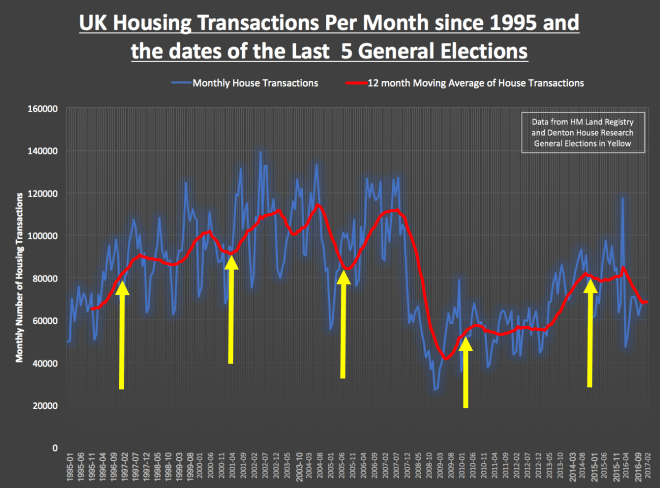
Look at the first graph below comparing the number of properties sold and the dates of the general elections

168 Graph One.png

It is clear, looking at the number of monthly transactions (the blue line), there is a certain rhythm or seasonality to the housing market. That rhythm/seasonality has never changed since 1995 (seasonality meaning the periodic fluctuations that occur regularly based on a season – i.e. you can see how the number of properties sold dips around Christmas, rises in Spring and Summer and drops again at the end of the year).

To remove that seasonality, I have introduced the red line. The red line is a 12 month ‘moving average’ trend line which enables us to look at the ‘de-seasonalised’ housing transaction numbers, whilst the yellow arrows denote the times of the general elections. It is clear to see that after the 1997, 2001 and 2005 elections, there was significant uplift in number of households sold, whilst in 2010 and 2015, there was slight drop in house transactions (i.e. number of properties sold).

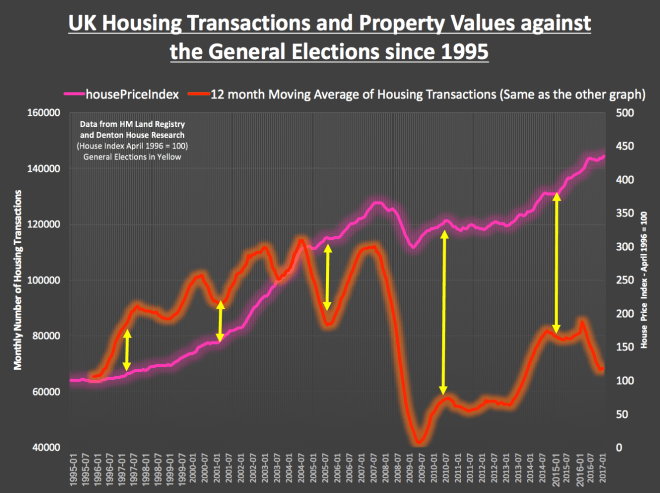
Next, I wanted to consider what happened to property prices. In the graph below, I have used that same 12-month average, housing transactions numbers (in red) and yellow arrows for the dates of the general elections but this time compared that to what happened to property values (pink line).

168 Graph Two.png

It is quite clear none of the general elections had any effect on the property values.  Also, the timescales between the calling of the election and the date itself also means that any property buyer’s indecisiveness and indecision before the election will have less of an impact on the market.

So finally, what does this mean for the landlords of the 20,530 private rented properties in Greenwich? Well, as I have discussed in previous articles (and just as relevant for homeowners as well) property value growth in Greenwich will be more subdued in the coming few years for reasons other than the general election. The growth of rents has taken a slight hit in the last few months as there has been a slight over supply of rental property in Greenwich, making it imperative that Greenwich landlords are realistic with their market rents. But, in the long term, as the younger generation still choose to rent rather than buy … the prospects, even with the changes in taxation, mean investing in buy-to-let still looks a good bet. If you want to read more about the Greenwich property market – then why not visit the Greenwich Property Market Blog for more information? greenwichpropertyblog.co.uk
2.57 Babies Born for Each New Home Built in the Greenwich area


166 image 2.PNG

As more babies are being born to Greenwich mothers, I believe this increase will continue to add pressure to the over stretched Greenwich property market and materially affect the local property market in the years to come.

On the back of eight years of ever incremental increasing birth rates, a significant 2.57 babies were born for every new home that was built in the Greenwich council area in 2016.  I believe this has and will continue to exacerbate the Greenwich housing shortage, meaning demand for housing, be it to buy or rent, has remained high.  The high birth rate has meant Greenwich rents and Greenwich property prices have remained resilient – even with the challenges the economy has felt over the last eight years, and they will continue to remain high in the years to come.

This ratio of births to new homes has reach one its highest levels since 1945 (back in the early 1970’s the average was only one and a half births for every household built).  Looking at the local birth rates, the latest figures show we in the Greenwich council area had an average of 72.7 births per 1,000 women aged 15 to 44.  Interestingly, the national average is 61.7 births per 1,000 women aged 15 to 44 and for the region its 63.9 births per 1,000 women aged 15 to 44.

The number of births from Greenwich women between the ages of 20 to 29 are closer to the national average, but those between 35 and 44 were much higher.  However overall, the birth rate is still increasing, and when that fact is combined with the ever-increasing life expectancy in the Greenwich area, the high levels of net migration into the area over the last 14 years (which I talked about in the previous articles) and the higher predominance of single person households … this can only mean one thing … a huge increase in the need for housing in Greenwich.

Again, in a previous article a while back, I said more and more people are having children as tenants because they feel safe in rented accommodation.  Renting is becoming a choice for Greenwich people.

The planners and Politian’s of our local authority, central Government and people as a whole need to recognise that with individuals living longer, people having more children and whilst divorce rates have dropped recently, they are still at a relatively high level (meaning one household becomes two households) … demand for property is simply outstripping supply.

The simple fact is more Greenwich properties need to be built

… be that for buying or renting.

Only 1.1% of the Country is built on by houses.  Now I am not suggesting we build tower blocks in the middle of the Cotswolds, but the obsession of not building on any green belt land should be carefully re-considered.

Yes, we need to build on brownfield sites first, but there aren’t hundreds of acres of brownfield sites in Greenwich, and what brownfield sites there are, building on them can only work with complementary public investment.  Many such sites are contaminated and aren’t financially viable to develop, so unless the Government put their hand in their pocket, they will never be built on.

I am not saying we should crudely go ‘hell for leather’ building on our Green Belt, but we need a new approach to enable some parts of the countryside to be regarded more positively by local authorities, politicians and communities and allow considered and empathetic development.  Society in the UK needs to look at the green belts outside their leisure and visual appeal, and assess how they can help to shape the way we live in the most even-handed way.  Interesting times!

For more thoughts on the Greenwich Property market – visit the Greenwich Property Blog greenwichpropertyblog.co.uk

Hard Brexit could cause 4,000 properties to be dumped onto the Greenwich Property market

165 pic 4

So all cards up in the air! A general election will be on the books, but one thing is for sure … whoever gets the job to deal with Brexit has a hard job on their hands (I’m just glad its not me!) As it currently stands, by not assuring the rights of EU citizens in the UK, Theresa May has squandered an opportunity to give peace of mind to our EU co-workers working and living in Greenwich (and the rest of the UK). No.10 Downing Street’s point of view is that in promising the rights of EU citizens in the UK, it will postpone the same guarantee to the 1.5 million UK citizens living in the other nations of the EU.

Putting aside the politics for one second, the simple fact is now Article 50 has been triggered, we have two years to make a deal with the EU; otherwise it will be a ‘hard Brexit’. Now you might not think a hard Brexit will affect you in your home in Greenwich … but nothing could be further from the truth.

Of the 249,991 people who are resident in the Greenwich Borough Council area, 172,234 were born in the UK, 9,885 were born in EU countries from West Europe and 6,014 were born in EU countries from the former Soviet States in East Europe (the rest coming from other countries around the world).

The rights of these EU citizens living in the Greenwich area are not guaranteed and will now be part of the negotiation with Europe. It is true a lot of our EU next door neighbours in Greenwich will have acquired rights relating to the right to live, to work, to own a business, to possess a property, the right to access health and education services and the right to remain in a UK after retirement… yet those acquired rights are up for negotiation in the next two years.

So, what would a hard Brexit do to the Greenwich property market?

Well a hard Brexit could mean the nuclear option when it came to the Greenwich housing market. It could mean that every EU citizen would have to leave the UK.

In the Greenwich Borough area, 4,216 of the 9,885 Western European EU citizens own their own home and (so they would all need to be sold) and 3,810 of the 6,014 Eastern European EU citizens rent a property, so again all those rental properties would all come on the market at the same time.

Hard Brexit and mass EU Migration would mean c. 4,000 properties being dumped onto the housing market in a short period of time, meaning there would be a massive drop in Greenwich property values and rents, causing negative equity for thousands of Greenwich homeowners and many buy-to-let landlords would be out of pocket.

While there is no certainty as to what the future will hold, both UK expats in the EU and EU citizens in the UK rights will no longer be guaranteed and will be subject to bilateral renegotiation.

All I ask is that the politicians are sensible with each other in the negotiations. A lot of the success of the Greenwich (and UK) property market has been built on high levels of homeownership and more recently in the last 10/15 years, a growth of the rental sector with lots of demand from Eastern Europeans coming to Greenwich (and the surrounding area) to get work and provide for their families. Many Greenwich people have invested their life savings into buying a buy to let property.