Greenwich Private Rents Hit £22.30 per sq. foot

207 all social media

As I am sure you are aware, one the best things about my job as an agent is helping Greenwich landlords with their strategic portfolio management. Gone are the days of making money by buying any old Greenwich property to rent out or sell on. Nowadays, property investment is both an art and science. The art is your gut reaction to a property, but with the power of the internet and the way the Greenwich property market has gone in the last 11 years, science must also play its part on a property’s future viability for investment.

Many metrics most property professionals (including myself) use when deciding the viability of a rental property is what properties are selling for, the average rent, the yield and an average value per square foot.

However, another metric I like to use is the average rent per square foot. The reason being is that is a great way to judge a property from the point of view of the tenant … what space they get for their money. Now of course, location (location, location in a Phil and Kirstie style) has a huge influencing factor when it comes to rents (and hence rent per square foot). Like people buying a property, tenants also have that balancing act between better/worse location, more vs. less money and size of accommodation (bigger and more rooms equalling more money) and where they live (location) verses making ends meet.

Interestingly, I know there are a lot of you in Greenwich who like to see my statistics on the Greenwich property market, so before I talk about the rental figures per square foot, I wanted to share the £ per square foot on the values. In Greenwich, the current AVERAGE figures are being achieved (and I must stress, these are average figures, so there will an enormous range in these figures), but on average, properties in Greenwich, split down by type are achieving …

  • Greenwich Detached Property – £641 / sq ft
  • Greenwich Semi Detached Property – £534 / sq ft
  • Greenwich Terraced Property – £563 / sq ft
  • Greenwich Apartments – £570 / sq ft

So, the rental figures:

The extent of space you get for your rent is replicated in the space you get for your money when buying a property. The average size of rental property in the Greenwich area is 759.1 sq ft (interesting when compared to the national average of 792.1 sq ft)

This means the average rent per square foot currently being achieved on a Greenwich rental property is £22.30 per sq ft per annum

So, what we can deduce from this?  Well the devil is always in detail!

Whilst I was able to quote the average overall figure and the fact my research showed it was quite clear from data that there is relationship between the average £ per sq ft figures on property values and average £ per sq ft on rental figures as a property grows in size. However, something quite intriguing happens to those figures, in terms of what the property will sell for and what it will rent for, when we change and increase the size of the property.

My research showed that doubling the size of any Greenwich property doesn’t mean you will double the value of it … in either value or rent. This is because the marginal value increases diminish as the size of the property increases. In layman’s terms … Subject to a few assumptions, double the size of the house doesn’t mean double the value … what really happens is a doubling of the size gives only an approximately 40% to 65% uplift in value, but here comes the even more fascinating part … when it came to the rental figures, double the size of the house meant only 20% to 45% in increase in rent.

In a future article, I will be discussing the actual added value an extension can bring … but in the meantime, in an overall and sweeping statement, most of the time it makes sense to extend if you are going to live in the property as long as the extension is proportionate to the property, but if you are going to rent it out … possibly not.
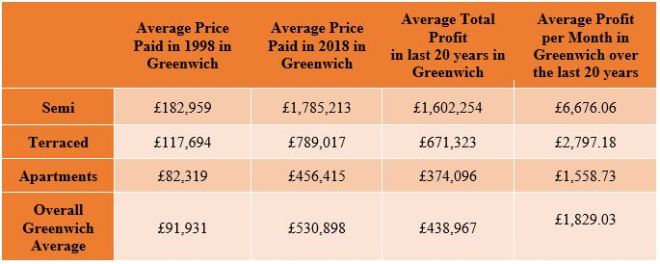
 

£1,829.03pm – The Profit made by every Greenwich Property Owner over the last 20 years

201 v1

As we go headlong into 2018, I believe UK interest rates will stay low, even with the additional 0.25% increase that is expected in May or June. That rise will add just over £20 to the typical £160,000 tracker mortgage, although with 57.1% of all borrowers on fixed rates, it will probably go undetected by most buy-to-let landlords and homeowners. I forecast that we won’t see any more interest rate rises due to the fragile nature of the British economy and the Brexit challenge. Even though mortgages will remain inexpensive, with retail price inflation outstripping salary rises, it will still very much feel like a heavy weight to some Greenwich households.

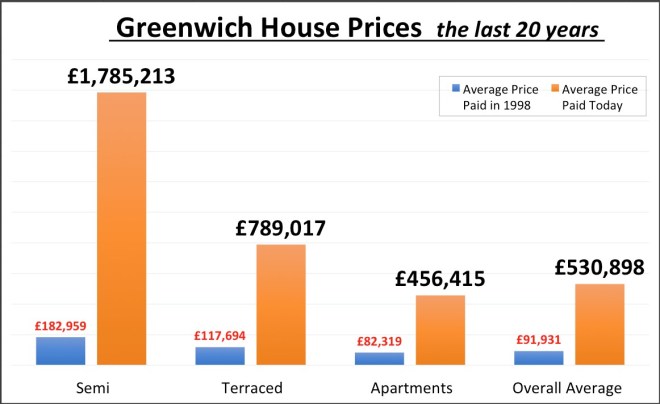
Now it’s certain the Greenwich housing market in 2017 was a little more subdued than 2016 and that will continue into 2018. Property ownership is a medium to long-term investment so looking at that long-term time frame; the average Greenwich homeowner who bought their property 20 years ago has seen its value rise by more than 480%.

This is important, as house prices are a national obsession and tied into the health of the UK economy as a whole. The majority of that historic gain in Greenwich property values has come from property market growth, although some of that will have been added by homeowners modernising, extending or developing their Greenwich home.

Taking a look at the different property types in Greenwich and the profit made by each type, it makes interesting reading..

Table 1

Graph 1

However, I want to put aside all that historic growth and profit and looking forward to what will happen in the future. I want to look at the factors that could affect future Greenwich (and the Country’s) house price growth/profit; one important factor has to be the building of new homes both locally and in the country as a whole. This has picked up in 2017 with 217,350 homes coming on to the UK housing ladder in the last year (a 15% increase on the previous year’s figures of 189,690. However, Philip Hammond has set a target of 300,000 a year, so still plenty to go!

Another factor that will affect property prices is my prediction that the balance of power between Greenwich buy-to-let landlords and Greenwich first-time buyers should tip more towards the local first-time buyers in 2018.

The Council of Mortgage Lenders expects the number of buy to let mortgages to drop by 34% from levels seen in 2015. This is because of taxes being increased recently on buy-to-let and harder lending criteria for buy to let mortgages, which means I foresee a gradual move in the balance of power in favour of first-time buyers rather than buy-to-let landlords. First time buyers will also be helped by The Chancellor eradicating Stamp Duty for all properties up to £300,000 bought by first-time buyers in the recent budget.

This means Greenwich buy-to-let landlords will have to work smarter in the future to continue to make decent returns (profits) from their Greenwich buy-to-let investment. Even with the tempering of house price inflation in Greenwich in 2017, most Greenwich buy to let landlords (and homeowners) are still sitting on a copious amount of growth from previous years.

The question is, how do you, as a Greenwich buy to let landlord ensure that continues?

Since the 1990’s, making money from investing in buy-to-let property was as easy as falling off a log. Looking forward though, with all the changes in the tax regime and balance of power, making those similar levels of return in the future won’t be as easy. Over the last ten years, I have seen the role of the forward thinking letting agents evolve from a ‘rent collector’ and basic property management to a more holistic role, or as I call it, ‘landlord portfolio strategic leadership’. Thankfully, along with myself, there are a handful of letting agents in Greenwich whom I would consider exemplary at this landlord portfolio strategy where they can give you a balanced structured overview of your short, medium and long-term goals, in relation to your required return on investment, yield and capital growth requirements. If you would like such advice, speak with your current agent – or whether you are a landlord of ours or not – without any cost or commitment, feel free to drop me a line.

With Greenwich Annual Property Values 7.9% Higher, This is My 2018 Forecast

200 V2

Looking at the newspapers between Christmas and New Year, it seemed that this year’s sport in the column inches was to predict the future of the British housing market. So to go along with that these are my thoughts on the Greenwich property market.

With the average 5-year fixed rate mortgage at 1.98% (down from 3.47% in 2014) and 2-year fixed rate at 1.47% (down from 2.37% in 2014), mortgage interest rates offered by lenders are at an all-time low (even with the slight increase on the Bank of England base rate a few months ago). Added to this, there has been a low unemployment rate of 6.1% in Greenwich, which has contributed to maintain a decent level demand for property in Greenwich in 2017 (interestingly – an impressive 699 Greenwich properties were sold in last 12 months), whilst finally, the number of properties for sale in the area has remained limited, thus providing support for Greenwich house prices, meaning …

Greenwich Property Values are 7.94% higher than a year ago

However, moving into 2018, there will be greater pressures on people’s incomes as inflation starts to eat into real wage packet growth, which will wield a snowballing strain on consumer confidence. Interestingly though, information from the website Rightmove suggested over a third of property it had on its books in October and November had their asking prices reduced, the highest percentage of asking price reductions in the same time frame, over five years. Still, a lot of that could have been house-sellers being overly optimistic with their initial pricing.

In terms of what will happen to Greenwich property values in the next 12 months, a lot will be contingent on the type of Brexit we have and the impact on the whole of the UK economy. A lot of people will talk about the Central London property market in the coming year, and if the banking and finance sectors are negatively affected with a poor Brexit deal, then the London market is likely to see more of an impact.

Nevertheless, the bottom line is Greenwich homeowners and Greenwich landlords should be aware of what happens in the rollercoaster housing market of Central London, but not panic if prices do drop suddenly in 2018. Over the last 8 years, the Central London house prices have grown by 89.6%, whilst in Greenwich, they have risen by similar figure of 83.3%. So if we do see a correction in the Capital, of say 5% to 10%, it will only take us back to Greenwich house prices that were being achieved only 12 to 18 months ago … and nobody was complaining or worrying then!

Hindsight is always better than foresight and predicting anything economic is all well and good when you know what is around the corner. At least we have the Brexit divorce settlement sorted and, as the UK economy and the UK housing market are intertwined, it all depends on how we deal as a Country with the Brexit issue. However, we have been through the global financial crisis reasonably intact … I am sure we can get through this together as well?

Oh, and house prices in Greenwich over the next 12 months? I believe they will end up between 0.8% higher and 2.3% higher, although it will probably be a bumpy ride to get to those sorts of figures.

If you would like to read more articles on my thoughts on the Greenwich property Market – please visit the Greenwich Property Market Blog

My thoughts on the future of the Greenwich Buy-To-Let Market

199 v2

I was recently reading a report by the Home website which suggested that hordes of landlords are selling their buy-to-let investments due to increasing burdens on them in the buy-to-let market. Their findings suggest the number of new properties that came onto the market nationally (for sale) jumped by 11% across the UK as a result.

Those increasing burdens include new tax rules coming in over the next 3 to 4 years and the announcement that all self-managing landlords (i.e. landlords that don’t use a letting agent to look after their buy-to-let property) will soon need to register with a compulsory redress scheme to resolve tenant arguments and disputes; as Westminster wants to heighten standards in the Private Rented Sector.

Interestingly I was chatting with a self-managed landlord from Greenwich Peninsula, when I was out socially over the festive period, who didn’t realise the other recent legislations that have hit the Private Rented sector, including the ‘Right to Rent’ regulations which came in to operation last year. Landlords have to certify their tenants have the legal right to live in the UK. This includes checking and taking copies of their tenant’s passport or visa before the tenancy is signed. Of course, if you use a letting agent to manage your property, they will usually sort this for you (as they will with the redress scheme when that is implemented).

If you are a self-managed landlord though, the consequences are severe because if you let a property to a tenant who is living in the UK illegally, you will be fined up to £3,000. That same Peninsula landlord popped into my offices in the New Year, and I checked all his paperwork and ensured he was on the right side of the law going forward – and I offer the same to any landlord in the Greenwich area if you want me to cast my eye over your buy to let matters (and at no cost – ok just bring in some chocolates for the girls in the office!)

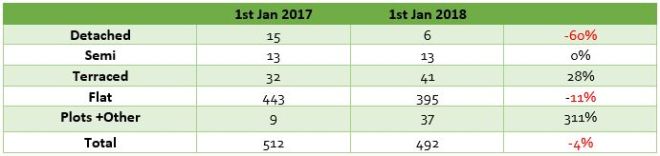
But what of all these extra properties being dumped onto the market in Greenwich? When I looked at the records the number of properties on the market in Greenwich now, as opposed to a year ago, the numbers tell an interesting story …

Table 1

Graph 1

Overall, Greenwich doesn’t match the national trend, with the number of properties on the market actually dropping by 4% in the last year.  It was particularly interesting to see the number of terraced increase by 28%, yet the number of detached on the market drop by 60%.

However, speaking with my team and other property professionals in the area, the majority of that movement in the number of properties and the types of properties on the market isn’t down to landlords dumping their properties on the market. The whole property market has changed in the last 12 months, with the majority of the change in the number and type of properties for sale due to the owner-occupier market, not landlords (a subject I will write about soon in my Greenwich Property Market blog later this Spring?). You see, for the last ten years, each month there has always been a small number of Greenwich landlords who have been releasing their monies from their Greenwich buy to let properties – as is the nature of all investments!

Nationally, the number of rental properties coming on to the market to rent fell by 16% in Q4 2017 compared to Q4 2016 .. but that isn’t because there are 16% less rental properties to rent – it’s because tenants are staying in their rental properties longer meaning less are coming on the market to be RE-LET.

Nevertheless, some Greenwich landlords will want to release the equity held in their Greenwich buy to let properties in 2018. All I suggest is that you speak with your letting agent first, as putting a rental property on the open market often spooks the tenants to hand in their notice days after you put it on the market (because they don’t like the uncertainty and also believe they will become homeless!). This means you have an empty property, costing you money with no rent coming in.  However, some letting agents who specialise in portfolio management have select lists of landlords that will buy with sitting tenants in. If you have a portfolio in the Greenwich area and are considering selling some or all of them – drop me a line as I might have a portfolio landlord for you (with the peace of mind that you won’t have any rental voids).

Youngsters unable to buy their first home in Greenwich – Are the Baby Boomers and Landlords to Blame?

197 pic for anything

Talk to many Greenwich 20 something’s, where home ownership has looked but a vague dream, many of them have been vexatious towards the Baby Boomer generation and their pushover ‘easy go lucky’ walk through life; jealous of their free university education with grants, their eye watering property windfalls, their golden final salary pensions and their free bus passes.

If you had bought a property in Greenwich for say £20,000 in first quarter of 1977, today it would be worth £605,111, a windfall increase of 2925.56%.

But to blame the 60 and 70 year olds of Greenwich for that sort of rise seems a little unfair, with the value of the homes rising like rocket, I don’t believe they can be censured or made liable for that. A few weeks ago, I discussed in my blog the number of people in the Greenwich area who have two or more spare bedrooms (meaning they are under-occupying the house). I see many mature members of Greenwich society, rattling around in large 4/5 bed houses where the kids have flown the nest years ago … but should they be blamed?

We are all just human, and the mature members of UK society have just reacted to the inducements of our property and tax system. The mature generations who joined the property market party in the 1970’s and 1980’s were able to take out huge mortgages, protected in the knowledge that inflation would corrode the real value of the mortgage, while wage gains would boost their ability to repay.

Neither do I directly blame the multitude of Greenwich buy to let landlords, buying up their 10th or 11th property to add to their buy to let empire. They too, are humbly reacting to the peculiar historic inducements of the UK property market.

So, who is to blame?

Well, hyperinflation in the 1970’s meant the real value of people’s mortgages was whipped out (as mentioned above). Margaret Thatcher and Nigel Lawson are also good people to blame with Maggie selling off millions of council houses and Nigel Lawson’s delayed ending of the MIRAS tax relief in 1987; meaning he too can get his share of indignation. The Blair/Brown combo doubled stamp duty in 1997 and again in 2000, which, as a tax on property transactions, precludes a more efficient distribution of the current housing stock. The Government has had plenty of opportunity to change the draconian stamp duty rules to incentivise those mature Greenwich house movers to downsize.

However, I have started to see over the last few years a change in Government policy towards housing. The new breed of Greenwich buy to let landlords that have come about since the Millennium, have had their wings clipped over the last couple of years, with the introduction of new tax rules (meaning it is slightly more difficult to make money out of property unless you have all the national information and Greenwich property trends to hand).

It’s easy to think the only reason that hundreds of first time buyers have been priced out of the Greenwich housing market is because of these landlords. Yet, I believe landlords have been undervalued with the Greenwich homes they provide for Greenwich people. With first time buyers struggling to save for a deposit, if it weren’t for those landlords buying up those homes over the last 10/15 years, we would have a bigger housing crisis than we have today. Since the global financial crisis of 2008/9, local councils have had to cut services, so certainly didn’t have enough money to build new homes … homes that were provided to Greenwich by these buy to let landlords.

Graph 1

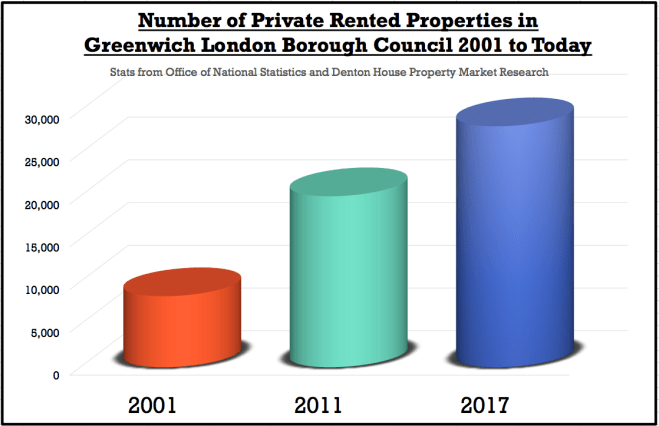
One side of the argument is that 1,169 homes are being bought up by buy to let landlords each year in the Greenwich London Borough Council area when otherwise they might have become available to other buyers, the other side of the argument is the current national average deposit is £51,800, which is, by far, the greatest barrier to those wanting to buy their first home. Those homes bought by local buy to let landlords are not left idle, as they equate to 8,184 of new homes for local people, most of whom who see renting as a better option because of the choice, the simplicity and the flexibility which renting brings.

In the 60’s/70’/80’s, the traditional thoughts that you were a failure unless you owned your own home have now all but disappeared, because if you ask many young people, they would probably say renting was the perfect option for them at certain times of their life.

Greenwich Apartments are only 24.8% more expensive in REAL terms than 10 years ago

197 v1

Roll the clock back to 2007 just before the credit crunch hit which saw Greenwich property values plummet like a lead balloon and the Greenwich property market had reached a peak with the prices for Greenwich property hitting the highest level they had ever reached.  Between 2008 and 2010, Greenwich property values lay in the doldrums and only started to rise in 2011, albeit quite slowly to begin with.

Nevertheless, even though property values have now passed those 2007 peaks, my research indicates that Greenwich property, especially flats/apartments, are now more affordable than people might think.

Back in 2007, the average value of a Greenwich flat/apartment stood at £323,786 and today, it stands at £488,078, a rise of £164,292 or 50.7%.

Between 2007 and today, we have experienced inflation (as measured by the Government’s Consumer Price Index) of 25.97% meaning that in real spending power terms Greenwich apartments are more affordable than you might initially think … because if you take off the inflation from that rise, apartments are 24.8% more expensive than in 2007. If the average Greenwich apartment (valued at £323,786 in 2007) had risen by 25.97% inflation over those 10 years, today it would be worth £407,873  .. meaning in real terms, property values haven’t gone up as much as you believe.

The point I’m trying to get across is that Greenwich property is more affordable than many people think.  Greenwich first time buyers can get on the ladder as 95% mortgages have been readily available to first-time buyers since 2010.

It really comes down to a choice and if Greenwich first-time buyers can get over the hurdle of saving the 5% deposit for the mortgage on the property – they will be on to a winner, especially with these ultralow mortgage interest rates, a mortgage can be between 10% and 30% cheaper per month than the rental payments on the same house.

So why aren’t Greenwich 20 somethings buying their own home?

Back in the 1960’s and 1970’s, renting was considered the poor man’s choice in Greenwich (and the rest of the Country) a huge stigma was attached to renting. However, over the last 10 years as a country, we have done a complete U-turn in our attitude towards renting – meaning that many people find renting a better option and a lifestyle choice.

There is no denying the simple fact that over the next 10 to 15 years, the people who choose to rent instead of buy in Greenwich will continue to rise.

Therefore, everyone in Greenwich has a responsibility to ensure that an adequate number of quality Greenwich rental properties are safeguarded to meet those future demands. Interestingly, what I have noticed though over the last few years are the expectations of Greenwich tenants on the finish and specification of their Greenwich rental property.

I have perceived that in the past, what a tenant wanted from their Greenwich rental property was moderately unassuming because renting a property was only a short-term choice to fill the gap before jumping on the property ladder. Before the millennium, wood chip wall paper and twenty-year-old kitchen and bathroom suites were considered the norm.

However, Greenwich tenants’ expectations are becoming more discerning as each year goes by.  I have also noticed the length of time a tenant remains in their Greenwich property is becoming longer (and this was backed up recently by stats from a Government Report), although I have noticed a tendency for many Greenwich landlords not to keep the rental payments at the going market rates  – maybe a topic for a future article for my blog?

The bottom line is this … Greenwich landlords will need to be more conscious of tenants needs and wants and consider their financial planning for future enhancements to their Greenwich rental properties over the next five, ten and twenty years –  e.g. decorating, kitchen and bathroom suites etc etc ..

The present-day and future situation of the Greenwich private rental property market is important, and I frequently liaise with Greenwich buy-to-let investors looking to spread their Greenwich rental-portfolios. I also enjoy meeting and working alongside Greenwich first time landlords, to ensure they can navigate through the minefield of rental voids, the important balance of capital growth and yield and ensuring the property is returned back to you in the future in the best possible condition.

Saving the 5% deposit means going without many luxuries in life (such as holidays, every satellite movie and sports channel, socialising or the latest mobile phone – even if only in the short term) therefore instead of saving every last pound to put towards a mortgage deposit Greenwich 20 somethings choose to rent.

Greenwich Property Market and Hammond’s Budget Promise to Build 300,000 more homes

195 v3

I miss the good old days of George Osborne as Chancellor, with his hardhat and hi-vis jacket. He must have visited every new home building site in the UK with his trademark attire! For the last few years, the nearest Philip Hammond got to donning a ‘Bob the Builder’ outfit was at his grandchild’s birthday party. However, with what appears to be a change in focus by the Tories to ensure they get back in power in 2022, they appear to have fallen in love with house building again with the Chancellor’s promise to create 300,000 new households in a year.

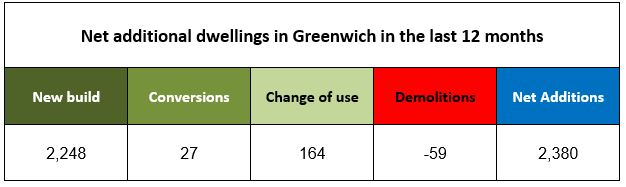
Nationally, the number of new homes created has topped 217,344 in the last year, the highest since the financial crash of 2007/8. Looking closer to home: in total there were 2,380 ‘net additional dwellings’ in the last 12 months in the Greenwich London Borough Council area, a staggering increase of 2518% on the 2010 figure.

The figures show that 94% of this additional housing was down to new build properties. In total, there were 2,248 new dwellings built over the last year in Greenwich. In addition, there were 164 additional dwellings created from converting commercial or office buildings into residential property and a further 27 dwellings were added as a result of converting houses into flats.

While these all added to the total housing stock in the Greenwich, there were 59 demolitions to take into account.

Table 1

I was encouraged to see some of the new households in the Greenwich area had come from a change of use. The planning laws were changed a few years back so that, in certain circumstances, owners of properties didn’t need planning permission to change office space in to residential use.

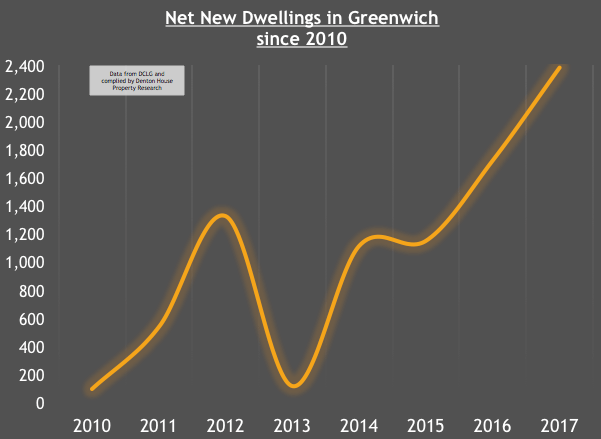
With the scarcity of building land available locally (or the builders being very slow to build on what they have, for fear of flooding the market), it was pleasing to see the number of developers that had reutilised vacant office space into residential homes in the local council area. Converting offices and shops to residential use will be vital in helping to solve the Greenwich housing crisis especially, as you can see on the graph, that the level of building has hardly been spectacular over the last seven years!

Table 2

Graph 1

Now we have had the autumn budget, Theresa May and Philip Hammond have set out their stall with housing as their key focus. I was glad to see the Government introducing a variety of changes to improve housing, including more funding for the supply side and an injection of urgency into the planning system.

The biggest question is, just where are the Government going to build all these new houses? Maybe a topic for a future article?

Back to the main point though and the focus on the housing market by the Tory’s is good news for all homeowners and buy to let landlords, as it will encourage more fluidity in the market in the longer term, sharing the wealth and benefits of homeownership for all. However, in the short term, demand still outstrips supply for homes and that will mean continued upward pressures on rents for tenants.

65.47% of Greenwich is Built on … Building Plot Dilemma or Not?

196 v2

Well the fallout from the recent Budget is still continuing.  I was chatting to a couple of movers and shakers from the Greenwich area the other day, when one said, “There isn’t enough land to build all these 300,000 houses Philip Hammond wants to build each year”.

…and if you read the Daily Mail, you would be forgiven for thinking the Country was at bursting point … or is it?

It was 60 years ago the first satellite was launched (Sputnik). All the Superpowers have used them to take high definition pictures of each other for decades, but now satellites and their high-powered cameras are being used for more peaceful purposes. The European Environment Agency (EEA) have been taking high definition pictures of the UK from outer-space to give us a focused picture of what every corner of the Country really looks like … and the findings will come as a surprise.

As my blog readers know, I always like to ask the important questions relating to the Greenwich property market. If you are a Greenwich landlord or Greenwich homeowner, this knowledge will enable you to make a more considered opinion on your direction and future in the Greenwich property market. Like every aspect of all economic life, it’s all about supply and demand, because over the last twenty or so years, there has been an imbalance in the British (and Greenwich) housing market, with demand outstripping supply, meaning the average value of a property in Greenwich has risen by 538.36%, taking an average value from £62,300 in 1995 to £397,700 today.

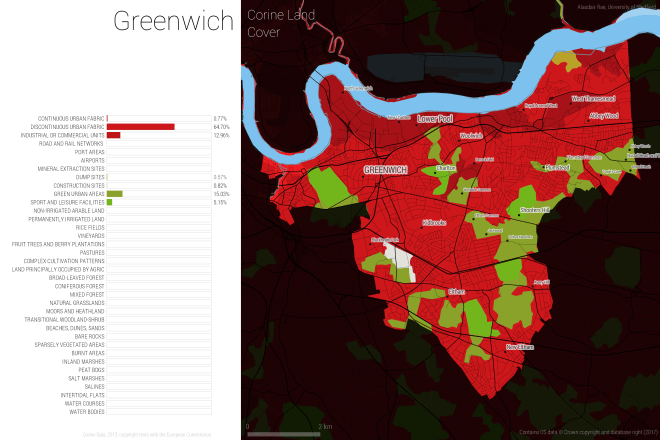
Using the information from the EEA and data crunched by Sheffield University with their Corine-Land Cover project, I posed them a few questions about the local area, interesting questions I would like to share with you …

Map 1

  1. What proportion of the whole of Greenwich is built on? 65.47%

That surprised you, didn’t it! In the study, land classified as ‘urban fabric’ defined has land which has between 50% and 100% of the land surface is built on, (meaning up to a half might be gardens or small parks, but the majority is built on).

  1. How much land is intensively built on locally?

Of that amount mentioned above, how much of it is high-density urban fabric? (i.e. where 80% to 100% is built on – still leaving 20% for gardens)  0.77%  – again I bet that surprised you!

  1. So how is the land used locally?
  • Sports Facilities                    5.15%
  • Industry                                 12.96%
  • Green Urban Areas             15.03%

…the rest being made up of various other minor types such as dump sites, etc.

Greenwich and the surrounding areas are greener than you think! In fact, I read that property covers less of the UK than the land revealed when the tide goes out. The assumption that vast bands of our local area have been concreted over doesn’t stand up to inspection. However, the effect of housing undoubtedly spreads beyond its actual footprint, in terms of noise, pollution and roads.

Now I am not suggesting for one second we concrete over every inch of the locality, but the bottom line is we, as a country, are growing at a quicker rate than the households we are building. I appreciate the emotional effect of housing is greater than other land use types because most of us spend the vast majority of our time surrounded by it. As Brits, we live our lives driving along roads, walking on footpaths and working and living in buildings meaning we tend, as a result, to considerably over emphasise how much of it there is.

In fact, I was only flying home recently back from a short break abroad, when I looked down and I was reminded just how green Britain actually is!

The bottom line is Greenwich people and the local authorities are going to have to put their weight into building more homes for people to live in. There is going to have to be some give and take on both sides, otherwise house prices will continue to rise exponentially in the future and Greenwich youngster’s won’t be able to buy their own Greenwich home, meaning Greenwich rents and demand for private rented accommodation in Greenwich can (and will) also grow exponentially.

Greenwich Rents Set to Rise to £1,769 pm in Next 5 Years

194 v2

It’s now been a good 18/24 months since annual rental price inflation in Greenwich peaked at 4.3%. Since then we have seen increasingly more humble rent increases. In fact, in certain parts of the Greenwich rental market over the autumn, the rental market saw some slight falls in rents. So, could this be the earliest indication that the trend of high rent increases seen over the last few years, may now be starting to buck that trend?

Well, possibly in the short term, but in the coming few years, it is my opinion Greenwich rents will regain their upward trend and continue to increase as demand for Greenwich rental property will outstrip supply, and this is why.

The only counterbalance to that improved rental growth would be to meaningfully increase rental stock (i.e. the number of rental properties in Greenwich). However, because of the Government’s new taxes on landlords being introduced between 2017 and 2021, that means buy-to-let has (and will) be less attractive in the short term for certain types of landlords (meaning less new properties will be bought to let out).

Interestingly, countless market experts assumed at the start of 2017, that the number of rental properties would in fact drop throughout the year. The assumption being as the new tax rules for landlords started to kick in, landlords looked to kick their tenants out, sell up and invest their capital elsewhere. (Although ironically that would lower supply of rental properties, decreasing the supply, meaning rents would increase again!).

Anecdotal evidence suggests, confirmed by my discussions with fellow property, accountancy and banking professionals in Greenwich, that Greenwich landlords are (instead of selling up on masse), actually either (1) re-mortgaging their Greenwich buy-to-let properties instead or (2) converting their rental portfolios into limited companies to side step the new taxation rules.

The sentiment of many Greenwich landlords is that property has always weathered the many stock market crashes and runs in the last 50 years. There is something inheritably understandable about bricks and mortar – compared to the voodoo magic of the stock market and other exotic investment vehicles like debentures and crypto-currency (e.g. BitCoin).

Remarkably, there is some good news for tenants, as Tory’s recently published the draft Tenants’ Fee Bill, which is designed to prohibit the charging of tenants lettings fees on set up of the tenancy. However, looking at evidence in Scotland, I expect rents to rise to compensate landlords, thus hammering faithful tenants looking for long-term tenancy agreements the hardest. This growth will be on top of any usual organic rent growth.  It really is swings and roundabouts!

So, what does this all mean for landlords and tenants in Greenwich? In my considered opinion,

Rents in Greenwich over the next 5 years will rise by 5.5%, taking the average rent for a Greenwich property from £1,677 per month to £1,769 per month.

To put all that into perspective though, rents in Greenwich over the last 12 years have risen by 35.8%. In fact, that rise won’t be a straight-line growth either, because I have to take into account the national and local Greenwich economy, demand and supply of rental property, interest rates, Brexit and other external factors.

Graph 1

In the past, making money from Greenwich buy-to-let property was as easy as falling off a log. But with these new tax rules, new rental regulations and the overall changing dynamics of the Greenwich property market, as a Greenwich landlord, you are going to need work smarter and have every piece of information, advice and opinion to hand on the Greenwich, Regional and National property market’s, to enable you to continue to make money.

One place for that information is the Greenwich Property Market blog 

Increase in Interest Rates to cost Greenwich Home Owners £1,223.54 a year

Greenwich homeowners will be among those affected by the latest rise in the Bank of England interest rates. The first increase in 10 years; they have just been raised from 0.25 percent to 0.5 per cent. This uplift comes as inflation hits a 51-month high of 2.9 per cent whilst the national unemployment rate is at an all-time low of 4.3 per cent.

Interestingly, the Governor of the Bank of England has indicated that the interest rate is likely to increase again over the next couple of years, but Mr Carney said mortgages and savings would not be affected in the short term. However, look at all the big banks and just about all of them have increased their standard variable mortgage rate..

The average Greenwich mortgage is £489,416

I have to ask by how much Greenwich homeowners (on variable rate or tracker mortgages) will see their repayments increase?

In the SE10 postcode there are 2,517 homeowners with a mortgage, of which 1,081 have a variable rate mortgage (the remaining have fixed rate mortgages). The total amount owed by those SE10 homeowners with those variable rate mortgages is £529,207,157, meaning the average monthly mortgage payment for those home owners on variable rate mortgages before the interest rate rise was £3,816.09 per month and now its £3,918.05 per month … meaning

The interest rate rise will cost Greenwich homeowners on average an extra £1,223.54 per year

Whilst this is the first raise in interest rates in over 10 years, it must be noted it is at a significantly low level compared to figures in the 1970s and early 1990s. Many of my readers talk of interest rates at 17 per cent when Sir Geoffrey Howe increased them to try and combat the hyperinflation (from the fallout of the financial crisis that hit Britain in the 1970’s) and Norman Lamont in September 1992 with the infamous Black Wednesday crisis, when interest rates were raised from 10% to 15% in just one day.

So, what will this interest rate actually do to the Greenwich housing market?

Well, if I’m being frank – not a great deal. The proportion of Greenwich homeowners with variable rate mortgages (and thus directly affected by a Bank of England rate rise) will be smaller than in the past, in part because the vast majority of new mortgages in recent years were taken on fixed interest rates. The proportion of outstanding mortgages on variable rates has fallen to a record low of 42.3 per cent, down from a peak of 72.9 per cent in the autumn of 2011.

If more Greenwich people are protected from interest rate rises, because they are on a fixed rate mortgage, then there is less chance of those Greenwich people having to sell their Greenwich properties because they can’t afford the monthly repayments or even worse case scenario, have them repossessed.

However, and this will be of interest to both Greenwich homeowners and Greenwich buy to let landlords …

.. for every 1% increase in the Bank of England interest rate, it will cost the average Greenwich homeowner on a variable rate mortgage £407.85 per month

So, what next? Because UK inflation levels are at 2.9 per cent (the country’s highest rate since April 2012) and the Bank of England is tasked by HM Government to keep inflation at 2 per cent using various monetary tools (one of which is interest rates) – you can see why interest rate rises might be on the cards in the future as increasing interest rates tends to dampen inflation.

Now of course there is a certain amount of uncertainty with regard to Brexit and the negotiations thereof, but fundamentally the British economy is in decent shape. People will always need housing and as we aren’t building enough houses (as I have mentioned many times in the Greenwich Property Blog), we might see a slight dip in prices in the short term, but in the medium to long term, the Greenwich property market will always remain strong for both Greenwich homeowners and Greenwich landlords alike.